Monday, December 14, 2009

Emerson Radio

Emerson Radio (MSN) was founded in 1915 as Emerson Phonograph when the phonograph was the only electronic gizmo in town (other than the telegraph). Now they make all sorts of marvels and have a subsidiary in China. This is one company that has seen a lot of changes. Radio came along and put Emerson Phonograph into receivership. It was revived as Emerson Radio and Phonograph in 1924. The along came the Great Depression, but they introduced the "peewee" radio in 1932, bursting them out of obscurity. They sold some of the first TVs in 1947. "Phonograph" was finally dropped from their title in 1977. They were the first to make the clock radio and have patented SmartSet, making them so that they automatically reset to the correct date and time after any power interruption. Don't you just hate those flashing "12:00"s ? They seem to have a long history of morphing into success no matter what happens.

The stock is currently in an interesting condition having been beaten senseless by the Great Recession. The eps has indeed suffered, but if you look at the rest of the picture you see this:

Revenue hasn't gone away and cash flow from operations has climbed to all time highs producing a very cheap price/cash flow of 2.6! If the earnings follow the cash upward, the stock could break out nicely. Technically, that appears to be what is happening:

If you like the cup and handle, this is breaking one. I like the behavior over the February/March market event, no price or volume reaction - all the sellers had left. The volume is only very slowly creeping back, certainly no topping type of volume yet, just the start of a stair step climb pattern with the steps punctuated emphatically with volume. And the A/D has just broken a long slow downtrend line and looks pretty strong.

Friday, December 11, 2009

Stump the TA Chump

It looks like the market is playing it's dastardly little game of stump-the-technical-analyst-and-make-him-look-like-an-idiot again. This has been a favorite all year long. Only an idiot would have bought anything in April during an obvious sharp bear rally. Bear markets don't end with a wild rally off a wild sell down - any smart technician knows that. All the oscillators read "suckers rally". But the suckers were right. And in July, the market was obviously rolling over having a lot of trouble clearing the descending 200 dma. I wrote a post here More Bear Signals on July 14 on why any sensible TA man would be short to the hilt at that point with the market's driver turning the wheels south. However, as I pointed out back then, the only thing that's been right all year is the game of follow-the-leader-groups, the leader groups being retail, tech, and the BDI (Baltic Dry Index). They were a lonely group back then calling for a north turn out of the market's funk, and they were right again as they had been in April.

Now we see the market technicals attempting to fool us some more:
Publish Post


Any technical analyst knows the small caps fizzle first in a run, and in early November we were having a major flameout with the Russell. Also we have this:

Here we see some major negative RSI and volume fade. So we should be an idiot and buy if the leader groups are right again. If you check the RLX, QQQQ, and BDI, they are sticking out their tongues at the technical analysts and saying "see you at the finish line, chump".

Friday, December 4, 2009

Oddsmakers Take On Iran

I posted yesterday on the well informed opinion of the intelligence service STRATFOR on war with Iran soon. As investorsinsight.com summed it up, the opinion is that the odds have recently (over the last 3 months) gone up "exponentially". They did not assign a probability figure to it but said that, while war is not inevitable, it is much more likely while pointing out that Israel seems to have assumed it to be a certainty in their intel planning.

These two entities, STRATFOR and Israeli intelligence, know more than the rest of us. So what do "the rest of us" think? Let's look at intrade.com for a collection of opinion who've studied it seriously enough to wager money on odds contracts. They bill themselves as "THE Leading Prediction Market" and invite you to "tap into the wisdom of crowds". This wisdom sets a probability for events of interest to occur by a certain date. For example, what would you say are the odds for Mike Huckabee to be the Republican presidential nominee in 2012? The pricing of the current contract you can buy has this chance at 10%. Turning to the markets, there was a running bet all year on the U.S. GDP declining 10% or more off the peak between Q4 2008 and Q4 2009 (inclusive). The wisdom of the crowds had this probability spiking to 50% in late February when the market was spiking toward the floor. It's currently at 0.9%. So this wisdom, as far as the markets are concerned, may be of use as a contrary indicator.

They have had a series of contracts for an Israeli and/or U.S. air strike on Iran over the last few years. I checked out the two covering about a year period for 2008 and 2009 and compared them alongside the sabre rattling out of Israel about an imminent strike. As the charts below show, there is some correlation between this sabre rattling and what the wisdom of the crowds think about a war (click to enlarge)
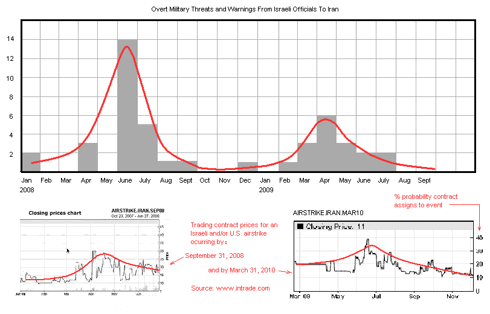
In both years, mid-year sabre rattling by Israeli officials roughly accompanied a chance of war outbreak spiking to as high as 40%! But then a slide into year end - current quote for a strike by March 31 is 11%.

But, as was the case with the February GDP/market outlook, the smart opinion may be just the inverse of this pattern.

The quieting pattern into year end isn't what you would expect from the saber rattlers if we are building to a blowup. But consider the observation of Andrew Apostolou and other analysts interviewed a few months ago on Israel's willingness to strike Iran.

"... it's unlikely, they say, that Prime Minister Benjamin Netanyahu will reach that conclusion in the coming weeks or months...Israel is locked in a wait-and-see mode, planning to let U.S. diplomacy exhaust itself. Matthew Silver, a historian at Emek Yezreel College in the Galilee, agrees: "Netanyahu figures, "Okay, let Obama talk to the mullahs. It's a preordained failure." That the Israeli prime minister is making loud noises about a possible military strike, Apostolou says, suggests one won't come anytime soon. "If the Israelis really wanted to scare the Americans, they'd say nothing. When the Israelis go really quiet, that's when you have to start worrying. But in the meantime, Israel will continue to match Iran's belligerent signals."

And theatlantic.com ran a July 13 article titled "The U.S. Should Worry When Israel Gets Quiet". Well, Israel does seem to have "gone quiet". Lately, their pronouncements have been preferring diplomacy if the military option is even mentioned. And now they say things like what Michael Oren, Israel's ambassador to the U.S. recently said on August 16 - Israel is "far from contemplating" a strike on Iran. That statement reminds me of the kid who denies eating any cake with chocolate smeared all over his face. It's interesting that the quiet zones in the above chart for this year and last coincide with the optimal time window of the year for a strike, September to November, when the prevailing monsoon winds keep the radioactive fallout and dust primarily in Iran and out of neighboring countries. I suspect that they were on the verge of doing the strike last year, but the financial crisis may have aborted it.

The opinion that knows, Israeli officialdom and STRATFOR, indicate the opposite of the slumping odds out to the March 2010 contract shown above. The current contract goes out to June 2010, and its current quote is a little higher at 18%. But all this would imply that the stock market impact would be severe - it doesn't seem to be very highly discounted.

Thursday, December 3, 2009

Is Iran Going To The Woodshed ?

More evidence is coming to light suggesting that investors should perhaps form a strategy around a massive strike on Iran coming up soon. I began posting on this emerging threat at my blog back in August - see

Art Cashin's Strange Comments - Aug. 21
Silence May Not Be Golden For Iran - Sept. 3
AWACS Prep In Iran Theatre - Sept. 24
Investing In Trouble - Oct. 3
Reading Between The Lines On Iran - Oct. 28

An Oct. 13 article over at investorsinsight.com discusses STRATFOR's new analysis. This geopolitical intelligence service is very well respected and is not given to alarmist rumor mongering. In late 2008, when there were many signs that a strike was being readied, an Aug 3 story by Reuters read "U.S. Israel attack on Iran Unlikely: STRATFOR Founder". The main reason was the growing financial crisis, which, as I've mentioned before, may have been the only stay of execution for Iran. But now, the well considered opinion reads "STRATFOR: Odds of War With Iran Spiking". Quoting their write-up:
"A new topic has rocketed to the top of STRATFOR's international concerns: the possibility of a war between the United States and Iran. There has been much discussion of this topic for years now, and STRATFOR has tended to dismiss it; there is a great chasm between remedial uranium enrichment programs and having a deliverable nuclear weapon. But events in the third quarter added credibility to the scenario...
The opening weeks of the fourth quarter will be dominated by 11th-hour negotiations primarily between but not limited to Washington and Tehran to see if war can be avoided. Washington and its allies will seek formal, transparent oversight for the entire Iranian nuclear program, and failing that, sanctions on the Iranian sector that is most vulnerable to foreign pressure: gasoline imports."
But STRATFOR doesn't believe gasoline sanctions have any realistic chance of working even if Russia seriously wanted to cooperate (which is doubtful) because the black market opportunities are too uncontrollable and too lucrative. Russia, Israel, Obama, and everybody knows this. They may go through the motions of more meetings and sanctions talk, but the enrichment deal was probably the last chance for a peaceful resolution.

Two news stories that STRATFOR says were deliberate intelligence leaks are of particular interest:
"Two major leaks occurred this weekend [the weekend of October 2-4] over the Iran matter.

In the first, The New York Times published an article reporting that staff at the International Atomic Energy Agency (IAEA), the U.N. nuclear oversight group, had produced an unreleased report saying that Iran was much more advanced in its nuclear program than the IAEA had thought previously. According to the report, Iran now has all the data needed to design a nuclear weapon...

The second leak occurred in the British daily The Times, which reported that the purpose of Israeli Prime Minister Benjamin Netanyahu's highly publicized secret visit to Moscow on Sept. 7 was to provide the Russians with a list of Russian scientists and engineers working on Iran's nuclear weapons program...

The message was twofold. First, previous assumptions on time frames on Iran are no longer valid, and worst-case assumptions must now be assumed. The Iranians are in fact moving rapidly toward a weapon; have been extremely effective at deceiving U.S. intelligence (read, they deceived the Bush administration, but the Obama administration has figured it out); and therefore, we are moving toward a decisive moment with Iran. Second, this situation is the direct responsibility of Russian nuclear expertise. Whether this expertise came from former employees of the Russian nuclear establishment now looking for work, Russian officials assigned to Iran or unemployed scientists sent to Iran by the Russians is immaterial. The Israelis — and the Obama administration — must hold the Russians responsible for the current state of Iran's weapons program, and by extension, Moscow bears responsibility for any actions that Israel or the United States might take to solve the problem."

This adds a new dimension to the Middle East problem - a strike on Iran may now be tantamount to a strike on Russia. The trip to Russia by Netanyahu with the results of Israel's undercover intel on the Russian scientists' work developing Iran's nuclear bombs for them was probably not a "stop this right now" visit. STRATFOR says the Kremlin keeps very close tabs on the whereabouts and activity of these people, and they know they are doing this. Rather this appears to have been a "the jig is up" visit by the Israeli brass. As the STRATFOR piece phrased it:
"Given that this specific charge has been made — and as of Monday not challenged by Iran or Russia — indicates to us more is going on than an attempt to bluff the Iranians into concessions. Unless the two leaks together are completely bogus, and we doubt that, the United States and Israel are leaking information already well known to the Iranians. They are telling Tehran that its deception campaign has been penetrated, and by extension are telling it that it faces military action — particularly if massive sanctions are impractical because of more Russian obstruction.

As the spy game goes, you intentionally blow your cover when you are sure you're not going to be needing it for awhile. In a section of the analysis they titled "A Question of Timing" STRATFOR reasons:

But there is a mystery here as well. To have any impact, the Russian involvement must have been under way for years. The United States has tried to track rogue nuclear scientists and engineers — anyone who could contribute to nuclear proliferation — since the 1990s. The Israelis must have had their own program on this, too. Both countries, as well as European intelligence services, were focused on Iran's program and the whereabouts of Russian scientists. It is hard to believe that they only just now found out. If we were to guess, we would say Russian involvement has been under way since just after the Orange Revolution in Ukraine [late 2004-early 2005], when the Russians decided that the United States was a direct threat to its national security.

Therefore, the decision suddenly to confront the Russians, and suddenly to leak U.N. reports — much more valuable than U.S. reports, which are easier for the Europeans to ignore — cannot simply be because the United States and Israel just obtained this information. The IAEA, hostile to the United States since the invasion of Iraq and very much under the influence of the Europeans, must have decided to shift its evaluation of Iran. But far more significant is the willingness of the Israelis first to confront the Russians and then leak about Russian involvement, something that obviously compromises Israeli sources and methods. And that means the Israelis no longer consider the preservation of their intelligence operation in Iran (or wherever it was carried out) as of the essence.

Two conclusions can be drawn. First, the Israelis no longer need to add to their knowledge of Russian involvement; they know what they need to know. And second, the Israelis do not expect Iranian development to continue much longer; otherwise, maintaining the intelligence capability would take precedence over anything else.

It follows from this that the use of this intelligence in diplomatic confrontations with Russians and in a British newspaper serves a greater purpose than the integrity of the source system. And that means that the Israelis expect a resolution in the very near future — the only reason they would have blown their penetration of the Russian-Iranian system.


Iran, well aware of all this, is behaving as if someone has just told them "the jig is up". They are frantically digging hundreds of new missile silos, held their big air defense drill, and are blustering to the world now that they are planning to build 10 new nuclear facilities, a behavior a European official recently described as "childish". Perhaps the child has just been made aware that he is in for a severe spanking.

Friday, November 27, 2009

Debt Dominoes, Here We Go ?

The Dubai debt scare focuses our attention to the one big thing that differentiates this recession, stimulus, and resultant rally from the previous cycles - the inordinate mountain of global debt. Despite the U.S. housing bust beginning clear back in 2006, you still have debt writers putting up indoor ski resorts in the middle of the desert. And Dubai isn't the only one still being this silly.
The domino effect, in my opinion, deserves more respect than most pundits and the market is giving it. Despite this view, however, I've been a bull on the market since late March. Back then, I wrote this view in a comment on a Seeking Alpha article by Bespoke Investment Group. The article pointed out a near term overbought condition predicated on the S&P being near a standard deviation above its 50 dma. This tends to occur as a single dot on a chart signaling the top of a bear bounce or as the start of a cluster of dots signaling the start of a big climb (click on link below to see article). My opinion was that it was signaling the start of a big climb, but note the caveat at the end of my comment:


S&P 500 Near Overbought Levels [View article]
It looks like it will be more a case of the multi-month climb like we saw into May '08 (the congested red dots in the middle of the graph). The conflicting technicals of the dangerous, uninvestable gyrations within the downtrend seem to be resolving into a buy signal (the kind VectorVest issued on 4/3/08 until their sell signal issued 6/11/08). If you look at the leading indexes (transports, financials, retailers) they are all just now breaking key resistance areas that would differentiate this rally from the other spastic bear market moves. The RLX retail index has now broken through the well entrenched horizontal line of resistance at 300, The transports and financials are now breaking the down sloping trendline through the highs. These leaders are following the technical steps of China's Shanghai index, which is now trading above a climbing 50 dma after a 50/200 cross (several steps ahead of the SPX).

The real test of these precarious spikes out of decline mode will come next week with the market's reaction to the wretched earnings and guidance that will replace all the nice rally talk. If the market has only mild or no reactions, then it won't be just another two week flying knife bear bounce anymore.

I've been expecting a good climb through the middle of the year '09, although I thought there would be a very sharp panic stricken VIX 80 dive to preceed it, which didn't happen. Major moves down such as we've had since '08 usually end that way. I'll take any kind of good move up I can get; but I suspect that toward the end of the year, it'll be ugly again. There are too many debt dominoes yet to fall.
Apr 03 20:26 pm |Rating: +2 0 |


We certainly have had the good climb since April 3 when I wrote that. I hope I'm wrong about the debt domino ugliness at year end, but it's hard to stop a domino field from proceding once the first one has been tipped. I've backed off to neutral on the market mainly because of how the small caps are behaving vs the big caps (see my Nov. 16 post) but Iran and now Dubai are problems as well. The leader groups that have faithfully called the market's direction all year (RLX, BDI) would have maybe a couple month's of mild consolidation and then more upside. But those dang dominoes! When a fool's ski resort in a desert in Dubai can hammer down your shoe maker's stock headquartered in Des Moines - well, that's dominoes for you.

Wednesday, November 18, 2009

Ag Boom Is Igniting

When anyone asks Jim Rogers for his best advice nowadays, he says "become a farmer". He is busy buying up farming operations all over the globe. It is the farmer, he says, that will be driving the Maseratis of the future, not the growers of creative debt instruments on Wall Street.

It is part of a seismic shift in valuing real assets over paper as is the case with commodities in general. But with food, there is much more too it than that. There is a food shortage developing that may wind up being more severe than say oil supply. A rapidly upgrading and very large BRIC population is placing a strain on global food production. They estimate total food production will have to rise by 70% over the next 40 years. That means $44 billion/year will have to be spent on Agriculture to produce that growth rate vs only $7.9 billion/year now.

This food shortage problem began to show itself in 2007 running crop prices and fertilizer stocks to the moon - and then back to earth with the whacking of the Great Recession. These investments have pretty much remained whacked this year, lagging about everything else, but they are reigniting. They have the potential to be some of the more explosive climbers available very soon, especially considering the historic droughts afflicting the chief food growing regions of the world right now. It is looking like global food production could be down 20% or more because of this pinch.

The food shortage is compounded with the currency debasement problems around the world. Nations will probably want to exchange devaluing paper bills more urgently for edible hard assets than for inedible ones.

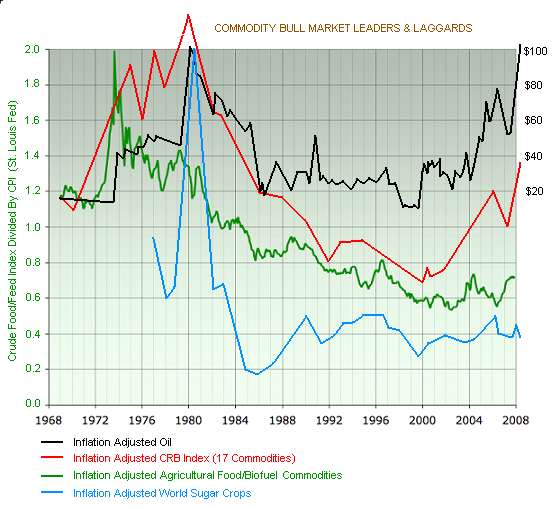
Food crop shortage is also compounded with the oil shortage because fuel crops such as sugar (60% of the world's ethanol) compete with meal crops. Inflation adjusted, crops have severely lagged other commodities as this historical chart shows: (click to enlarge)

Using the heights achieved during the previous commodity bull market as an inflation adjusted reference, you can see that crops have of lot catching up to do. Be a farmer!

Monday, November 16, 2009

Talking Phase May Be Over With Iran

As discussed in some of my previous posts on Iran here at my blog, the diplomatic talking efforts to resolve the nuclear facilities issue with Iran seem to have come to an end. DEBKAfile has just published a report this evening on top U.S. and Israeli intelligence and defense officers meeting in Israel. They said:

Our intelligence sources report that frequent Middle East visits by high-ranking American intelligence teams are rare occurrences. Worthy of note is they are immersed in a second round of talks with their Israeli colleagues in the first half of November, in between two other related events: the joint US-Israel Juniper Cobra 10 ballistic defense exercise which ended last Tuesday and the publication of the much-awaited UN nuclear watchdog's next report due out Monday, Nov. 16. This report should lay out the findings of the IAEA inspectors at Iran's uranium enrichment plant near Qom

Those findings reportedly will say that the plant was designed "especially" for nuclear weapon enrichment levels and was a military installation.

sources say that the US-Israel intelligence conferences ongoing at present are the final touches to the process the Obama administration has instituted of strategic give-and-take with Israel ahead of a possible outbreak of war with Iran. The alignment has been going forward on four levels:

1. Communications between the White House and the Israeli prime minister's office, which are handled at the Washington end by Dep. National Security Adviser Tom Donilon, who enjoys ready access to the president.

2. An open line to defense secretary Robert Gates which defense minister Ehud Barak set up when he visited the Pentagon last week.

3. Direct interchanges between the two army chiefs, Chairman of the Joint Chiefs of Staff Adm. Mike Mullen and IDF Chief of Staff Lt. Gen. Gaby Ashkenazi.

4. Frequent conferences between US and Israeli intelligence heads.

Political, military and intelligence integration between the US and Israel on this comprehensive scale has been practically unknown in recent years. It serves the dual purpose of a demonstration of close American-Israel military cooperation while at the same time safeguarding the Obama administration against Israeli surprise moves in relation to Iran.

Sunday, Nov. 15, President Obama and Russian president Dmitry Medvedev said in Singapore that time was running out for diplomacy to resolve the crisis over Iran's nuclear program. Medvedev added that if discussions failed to yield results, "other means" could be used.

Tehran delivered its comeback the same day: Iranian president Mahmoud Ahmadinejad declared grandiloquently: "Iran is a great world power whose strength is unlimited and on whom no other state would dare impose sanctions," while parliament speaker Ali Larijani blasted America whom he accused of backing the Saudi bombardments killing Muslims (Shiites in Yemen). Obama is worse than George Bush, said Larijani: "His promise to change US policy toward Tehran amounts to nothing." He flatly rejected the latest Western proposal to resolve questions about Iran's nuclear program (overseas processing of enriched uranium) as "unimportant" and "irrational".

Sounds like the Iranians are through talking too. In another DEBKA piece, they say "the Iranians are frenziedly digging hundreds of new missile launch silos" to prepare for Israel. Of the two intelligence sources, DEBKAfile and STRATFOR, I trust STRATFOR more. But this agrees with what STRATFOR said in that they believe Joe Biden's policy speeches in Europe about 3 weeks ago signalled "A Change In American Plans On Iran" as I posted about here on November 9. STRATFOR believes "...this means the United States must choose between an Iranian bomb or employing the military option."