Wednesday, August 10, 2011

Gold Technical Update

Gold may be breaking into the next phase of its bull market. Jim Sinclair's math has a long history of correctly predicting gold, not just in this bull market but in the 1970s bull market. He is now saying that the $1764 level is a swing point into a steeper climb similar to $524 was in late 2005.


Then, as now, gold was faithfully obeying the 140/200 ema moving average pair (red and blue lines) as support and the trend line shown as resistance. Then a break of this resistance occurred with a move to $524, a test of old resistance as support, and a huge new move into the next bull phase. As a weird coincidence from an entirely independent means of analysis, David Nichols' monthly fractal forecast is currently putting gold into a 64 day growth cycle into early October that he says will be the strongest yet in the entire bull market. That's 64 trading days (closer to 3 months calender). For those of us who simply like to study lines of support and resistance, it is also obvious that a change has occurred:


This chart is very similar to the 2005 chart above with the $524 swing point, but with the new $1764 swing point. It shows a pretty stable 3 year phase of gold's bull where a persistent line of resistance turns all the rallies into declines. There was a brief breach at the end of the strong 2009 four month cyclical move. The current breach is occurring at the beginning of this typical August to November strong period. This all implies a big bust of the 3 year channel.

I have outlined my disagreements with David Nichols' fractal analysis in other articles. My only problem back in 2010 was with his 64 month fractal or about a 5 year time limit on the high growth part of the overall bull market for gold, which he reckoned was to turn to bear market in February, 2011. I argued that this parabolic bull fractal pattern had other variations longer in duration that would go well beyond February, 2011, and that the current gold bull seemed to be an example of these. Well, February has come and gone, and I think it's safe to say there was no arrival of a bear market. But I can find little fault with Nichols' month-to-month range fractals - they have been stunningly accurate over the years. Jim Sinclair's call about $1764, David Nichols' call for the strongest 3 month move up yet, and the above simple support/resistance map all agree - gold is entering a new phase, and it ain't a bear market.

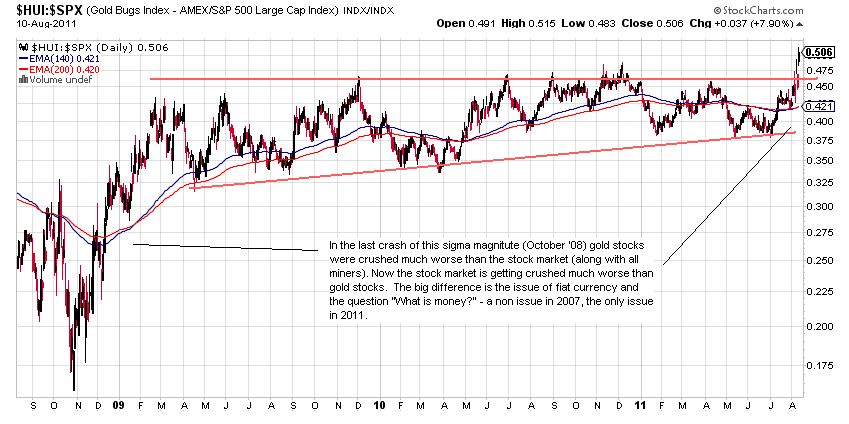
The cold calculating methods above also agree with a phase change in psychology that I believe has occurred over the last 3 years. This involves the basic question "What is money?" Well, it's that green and gray stuff passed around or it's electronic equivalent you may say. But is it? Is it really? That's what we used to think back in 2007. Is that what they're thinking over in Europe today? You can see this sea change in a 3 year chart covering the last two mega market crashes:


Here we have the gold stock index / S&P 500 ratio charted from mid 2008 to now. It drops when the gold stocks are under-performing the broad market and vice versa. As you can see, there is a vast difference between then and now. Why? There is a fundamental change in view going on as to what is money.

I have posted a discussion of this rapidly changing view with some interesting testimony by Ben Bernanke last month before Congress over at seekingalpha.com - just put my name in their search bar. The post is "Gold's New Phase And The Coming Revolution". It should be up in a day or two if it's not there yet.


Thursday, July 28, 2011

What The Debt Fools Are Up Against

As the ineptitude of our elected representatives continues to amaze regarding the debt issue, I think it's interesting to keep in mind what they are dealing with - the history of their own ineptitude. Its the bogus political "process" (the nicest word I could think of) that has created the nearly unsolvable problem they are working on. When you look back at history, you can see the political spats that accompanied each leg up in the debt parabola that is at a blow-off stage now:


This history shows how the recklessness of the 20s put us into the Depression in 1929 followed by a huge ramp-up in debt over the next 5 years. This reached an unworkable level and had to come back down out of necessity, but the recklessness and the debt that ensued went up out of political "process". The citizenry of that time saw no sense in doing the debt this way, but they had to watch helplessly as their elected representatives did it anyway.

Good sense prevailed for decades as the painful lessons of the '30s were practiced. Then we became entangled in the Cold War with the Soviet Union, and the political process was reckless budget balancing to out-arm and bankrupt the USSR. Then came the defeat of the USSR, but instead of the gigantic budget peace dividend that should have followed, we ran up against another enemy of the state - the banksters. They went on a creative binge of debt instrument "financial weapons of mass destruction" as Buffet calls them, and over the '90s they were the political process of choice. Standing in their way was not conducive to a political career.

If you gauge a time frame to a debt resolution to be similar to what happened from 1930 to the mid '30s after the start of the bear market, you see on the chart above that, if a secular bear market started in 2000, we should have had some kind of debt climb reversal around 2005, like the mid '30s. But perhaps because the fed has become more adept at funny money, things went on as usual.

But now another debt induced recession has resulted in another bear market, and five years from it takes us to about 2012 for some kind of dismantling of the debt mountain. That's what the fools in Washington are beginning to grapple with now and what will be dealt with in the 2012 elections.

Saturday, July 16, 2011

The Hot Money In Silver

Silver, the hot headed more volatile twin of gold, recently did one of those stunning runs to the upside, briefly hitting $47, crushing the shorts and dumbfounding all those who sold an overbought condition at the base of the spike. This was a significant departure from gold, which did no such thing. Now since we have an R squared between silver and gold that very typically runs around 0.9 or higher, meaning that the two correlate extremely closely, we must ask ourselves just what the heck was going on here.

Silver's behavior has caused many, including Jim Cramer, to be negative on silver but positive on gold, because, as Cramer recently remarked on his show, silver still has too much hot money in it. He flatly stated to stay away because "silver is going to $28". Hot (overleveraged) money was certainly the nitro that fueled the one month spike to $47 before the margin rules were tightened. But what is the case now?

Silver is doing what markets do to an overbought condition - a correction. And corrections very typically follow the classic ABC pattern where an initial sharp pounding is followed by a pause consolidation and then the final sharp decline to a bottom. We have had "A", are now in "B", and are awaiting a "C" which would indeed take the price to about $28. This would be enhanced by the market's general jittery feel about the debt default situation in the US and Greece and its effect on all things economy sensitive, as silver is.

That plausible scenario, however, is looking less and less likely. Lets look at a side by side comparison between gold and silver:


First, we see gold went onto a consolidation trading range in April. Now lets look at silver:


Here we see that silver did essentially the same thing except for the hot money spike that lasted for a month, shown in orange above. If you take away that aberration, you have silver following what gold is doing very closely - compare the charts. The ABC correction of the hot money warp seems to be fading into the tight correlation with gold - and gold is clearly breaking out of the consolidation to the upside. The ABC correction would have silver going far below the 140 day ema (blue line above) which would bring into question the whole silver bull market. That is looking less likely now, and a more sustained advance is probably coming. I hate hot money as much as Cramer or anybody, but silver's harmful hot money seems to be mostly laundered out at this point.

Saturday, June 18, 2011

Editorial Note

A note for those following my blog. SeekingAlpha.com recently started a Premium Article feature for their contributors. This allows a contributor to publish some of their articles on their site as exclusives (with a little compensation and the proviso that they not publish them anywhere else on the web). I've been publishing several of my articles this way, which means I can't post them here at my blog. So all my articles that don't get posted here can be read at seekingalpha.com - just type in my name, Bruce Pile, on their search bar to bring them up in an index that appears on the right labelled "Latest Articles".

Monday, May 30, 2011

Is America On The Revolution Contagion Hit List ?

One by one they are being mowed down. First it was the Tunisia uprising, and Ben Ali, regime chief since 1987, flees the country. Then swiftly following is the Egyptian revolution, and Hosni Mubarak, regime head thug for 30 years, flees the country. Now quickly coming to a boil are two more head thugs and their long lived, stable empires - Muammar Qaddafi in Libya, in power since he tangled with Reagan, and Bashar al-Assad in Syria, who together with his father has ruled for 40 years. What the heck is happening? These multi-decade power brokers are being dismantled in a matter of months.

It could be a good bit Iran stirring up malcontent for its own geopolitical advantage as many claim. But they have to have a big groundwork of simmering malcontent to begin with. What is all this malcontent and why is it detonating so easily now? I think a lot of it has to do simply with two things - the food shortage and the tech revolution. How so? Well the basic problem with all these people is that they live under the iron boot of freedom repression and forced poverty. They have been for many years, but now the developing food crisis is touching off violence and the smartphone revolution, which I've been predicting since 2009, is greatly facilitating it. The typical revolutionary in these countries has been described as having "a rock in one hand and a cell phone in the other". The thugs can censor the news and lie all they want, but the average Joe in all these places can now learn and organize via phone, and they aren't taking whatever the thugs are giving out anymore.

So what does all this have to do with a similar revolution here in America? Aren't we richer than that and with a better government? Well, I don't know. We may be experiencing the same thing only at a much higher level of comfort. Instead of Ben Ali's regime running things, we have had Ben Bernanke's regime running things for decades. If you include his "fathers" going all the way back to the 1913 founding of the Fed, these thugs have had their way for a hundred years. And what is the result? - big banks too big to fail (or be prosecuted for crimes against the average Joe). Times are still not too good for main street, but excellent for Wall Street. Our fed induced debt burden is now poised to drown our middle class, and our middle class is grabbing a rock in one hand and a smartphone in the other.

Like the fleeing thugs the global Tea Partiers are targeting, the central banker/economy planner elite of the US :

a) say to the other countries, you need us for stability. It would be chaos without us

b) rule by brute military force

c) have a fast growing share of their country's wealth in the hands of a privileged few - oil revenue in Saudi Arabia, financial weapons of mass destruction in the US

The Tea Party revolution in the last election seems to have said the time for this is up. Real government spending cutters were elected. Wisconsin's state senators fleeing the state over the budget battle feels a little like Mubarak fleeing Egypt.

The average Joe American does not want point (a) above as our economic plan. Point (a) was cleverly illustrated by Peter Schiff's story about Consumer Island. He tells the tale of a shipwreck leaving a group of some Asians, Brazilians, and an American on an island. To survive they had to divide up the jobs. One Asian was given the job of fishing. Another was given the job of hunting in the middle of the island. And the Brazilian was given the job of gathering the fire wood. The American was given the job of eating. So they all had jobs and at the end of the day, they all gathered around and the American would eat. But he would save enough for the others so that they could repeat the next day.

China and many others may just boot the American off the island if we don't soon stop chasing capitalism and the entrepreneurial spirit out from our borders with government-knows-best economy-by-committee Five Year Plans. We are becoming the global village idiots, not just of energy policy, but of every other kind of policy. And this is a prime mover in the bull market in gold and silver. Gold's price is a judgment on the soundness of the reserve currency and the government example being set by it.

I was struck by what Donald Trump said to Piers Morgan recently on his CNN show. I'm not a fan of Trump or his possible run for the presidency. But in discussing his international dealings, Trump pointed out a key problem that he says he, or somebody, needs to fix. Referring to the nations around the world, he kept repeating "they don't respect us".

"A wise and frugal government which shall leave men free to regulate their own pursuits of industry and improvement, and shall not take from the mouth of labor the bread it has earned - this is the sum of good government."
These words could well have been said by anyone on Consumer Island or any Tea Party revolutionary. But they were said by Thomas Jefferson.

Sunday, May 15, 2011

Market Changing Stripes ?

I've generally been pretty bullish on the market since April of '09 with only some neutral danger periods now and then giving me pause. The leader groups I follow, retail (RLX), Baltic Dry Index ($BDI) before the ship overbuild problem, tech, etc. have been indicating continued upside with only typical bull pullbacks. But now its technical behavior is giving me plenty of pause. The leader groups continue to behave well - outperforming and wanting to drag up the rest of the averages. But here is what I'm getting worried about.

If you look at what happens at major moves up and before major moves down, you see this


This was the last half of 2007 and we know what followed. Other bull runs display these divergences toward the end. This divergence trend analysis works better on broad averages than individual stocks, but it is typical behavior there as well:


Here we see Headwaters' recent behavior. Its nice climb from mid last year telegraphed its end with divergence.

What's happening now with the S&P 500 ?


Egad ! It's starting to act badly. I'm not saying a radical decline must follow, but maybe some cooling. Another tell tale marker of a turn is what the "cereals and soaps" do. When they suddenly start turning up and being a standout group, problems with economic growth are being felt by the market. This certainly was the case in late 2007, and guess what, they are becoming a conspicuous group now. Examine the charts for '07 and the current charts for HRL, UN, GIS, K, PG, KFT.

Another nagging problem is market sentiment. It's been too high, which didn't bother me when a horrific selloff was being feared back in February, but the mild 7% correction back then didn't work off much of that exuberance. But now we have these technicals turning. According to the numbers tracked by a blog that specializes in this, the Nasdaq sentiment is at a 5 year high right now. I don't know what fundamentals would be turning the market - angst over the end of QE, trying to raise interest rates with a mountain of debt that we already can't service. I don't know. But the charts have thought it all through, and they know more than I do.

And then there is the monster earthquake coming in a week or two that will split the US down the middle. A small point but I thought I'd mention it. It seems like Mother Nature is throwing a hissy fit of quakes all over the world the last few years. But are they really increasing? And is Mother Nature being helped? (click to enlarge images)

This chart shows that what has really been increasing is the people being killed by quakes - not so much the raw number of them occurring. So if the number of quakes is only rising modestly, why, since about 2003, have they suddenly become so destructive and deadly, as if they started seeking out the heavily populated areas with an evil mind of their own? Well, conspiracy theorists have long held an answer to that - HAARP. The High Frequency Active Auroral Research Program was one of those Star Wars defense plans in the Reagan years that were a big political debate issue. They were pretty much all voted down except for HAARP.

They went ahead with this and construction began in 1993. It is a joint project with the US Navy and the US Air Force, with patents based on Tesla in both high frequency and ELF technology.
The ELF part (extreme low frequency) is of particular interest to the conspiracy claims that, not only do the original patents and technical write-ups suggest this technology will be used to control weather, it will also be used in tomography to probe deep into the earth the way normal frequency transmission can not (your car radio blanks out when you go through a tunnel). The stated intent for ELF are things like mapping underground munitions, bunkered nuclear sites, etc. But many claim that HAARP is being weaponized not only for weather control, but as a tectonic weapon - inducing earthquakes.

Nicola Tesla, the "father of modern electricity" whose patents HAARP is based on, once built what was called an "earthquake machine" in his New York lab, disturbing the neighborhood and bringing the police to investigate. He once had to hammer the machine off to stop a quake he induced. This was a tiny 6 pound machine based on resonant frequencies that could be attached to a building and, with the right frequency dialed in, once induced a quake in a steel skeleton being erected, so that the steel workers at the top came scrambling down thinking an earthquake was in progress.

This was all around 1898, and the hub-bub over such a thing as an earthquake machine has gone away - until now. With the dramatic rise in mass-killer earthquakes since 2004, it's being noted that the massive antenna array buildout in HAARP's Gakona, Alaska facility, by far the most powerful of its kind, coincides closely with the rise of these killer quakes. The facility was completed in 2007. There is some correlation between strong magnetic field disturbances on HAARP's instrumentation on their website and major quakes if you survey activity in the 3 days previous to the quakes (about a 1 in 9 chance occurrence as near as I can figure). Earthquakes induce magnetic disturbances, which is why animals can sense them days in advance. But man-made looking signals, that only started showing up since about 2004, have a hoard of paranoid types blaming HAARP for inducing killer quakes with ELF resonant frequencies the way Tesla did with his crude 6 pound mechanical resonant version.

There are several different geopolitical takes on who may be doing this and why, but they agree on the people involved being heavily into the occult. I am not an expert on occult numerology, but a basic tenet is that there are what they call the "master numbers" - they are 11, 22, and 33- and they believe strongly in planning major events around these numbers.

The conspiracy nut jobs aren't the only ones leery of HAARP. Exonews recently had a story "European Parliament Issues Warnings On HAARP". The European leaders wanted to have more information on what they were doing with this research, concerned about its impact on weather and other things. This parliament action was taken in 1998, the article rehashes their concerns today.

The US Geological Survey's site usgs.gov has a long list of what they call "Historic Earthquakes" basically meaning the most destructive ones. If you refine this list to just the big killers - those with over 20,000 dead, you wind up with a list of five - all five occurring in 2004 and later. Of those five, three occurred on either the 11th or 12th. You can easily figure the math probability of that happening by random chance, 1 in 25.

Added to these happenings not likely by chance is what is happening with the weather lately. Supposedly the bread and butter of HAARP, other than incinerating incoming missiles, is weather control. Radar watchers claim they can spot unusual weather events days in advance by watching for "HAARP rings". These are near perfect, unnatural looking circles; and a huge rash of them popped up clustered in the New Madrid fault system in late April. I was stopped in my tracks the other day when I saw a CNN weather map showing the total rainfall amounts the past month or so. The very high amounts formed a near perfect map of the fault system. The map below shows flood warning counties as of May 6 with the insert showing the damage zones for the New Madrid:


The two satellite photos show the fault zone a year ago (top) and on this May 6 (bottom). Why has it rained so much over just the fault zone? I didn't think there should be any connection between rain and quakes until I checked. If they dam rivers, they often get small quakes. But probably the main attraction for the alleged disaster makers with all the focused rain is soil liquefaction. When the soil is wet, earthquake damage is vastly increased. Shaking wet soil causes it to go mushy. This quake feature happens a lot, but Japan and others lately have suffered severe bouts of it.

I've seen Agri science studies for rice-growing in eastern Arkansas where they gauged optimal "soak time" for the soil in this area of the fault (to get surface applied fertilizer entrained). They found it to be "at least 3 weeks". That suggests maybe an optimal liquefaction window of late May or early June. Conspiracy theorists point out that FEMA has a history of running drills for disasters just ahead of when they actually happen - when they are at the height of readiness. The idea is ever more dependence on the federal government with each disaster. They impose laws to deal with them, but don't take them back once the disaster is over. NLE 2011 is a massive FEMA exercise for a major New Madrid quake scheduled for May 16-21, about the same time frame for maximum liquefaction damage (and at a 22 number - May 22).

How much weight an investor should give to this quake threat depends on how much tin foil you wear in your hat I suppose (these guys claim a lot of things that don't happen). But I've gotten a lot more defensive with my portfolio strategy for a variety of reasons - very high cash. If you want a stock that typically benefits from the increasing earthquake disasters, whether by plot or by nature, take a look at Taylor Devices TAYD. This very small company in New York makes the products that allow buildings to absorb ground movement with little damage - basically gigantic shock absorbers. They routinely retrofit large buildings with these things easily and economically. I don't see what's so easy about cutting off a building at its foundation, jacking it up, and bolting on these things - but they do it all the time! And they have been doing a good business with it:


It's not grossly undervalued, or heavily insider owned (only 6%) but a stable, successful business. Quake protection is all they do, and they are about the only ones who live or die by this one product line. ITT and Kayden are the only publicly traded competition listed by Yahoo Finance, and with them this product is a small side line. TAYD tends to jump instantly in response to major, destructive quakes:


But, of course, if a major quake destruction would hurt the market enough, TAYD might initially react more like it did in late '08 (down like everything). If the New Madrid were to become more active, it would suddenly place a huge area of buildings in the midwest, that were built with little thought about earthquakes, into the market for some quake retrofitting.

Tuesday, March 22, 2011

Is Gold Now The Last Safe Haven Standing ?

Gold usually must compete with other choices for safe haven money. Bonds, real estate, and the world's reserve currency, the US dollar are the chief rivals. Real estate has become a troubled no man's land for investors. Bonds have been very popular, but now many people, using the term "bond bubble", are turning on them, including none other than Bill Gross, the biggest bond fund manager in the country. He has now become an outspoken critic of the federal deficits and the Fed's loose money policies. In a gurufocus.com piece, he states:

"...nearly 70% of the annualized issuance since the beginning of QE II has been purchased by the Fed, with the balance absorbed by those old standbys – the Chinese, Japanese and other reserve surplus sovereigns. Basically, the recent game plan is as simple as the Ohio State Buckeyes’ “three yards and a cloud of dust” in the 1960s. When applied to the Treasury market it translates to this: The Treasury issues bonds and the Fed buys them. What could be simpler, and who’s to worry? This Sammy Scheme as I’ve described it in recent Outlooks is as foolproof as Ponzi and Madoff until… until… well, until it isn’t. Because like at the end of a typical chain letter, the legitimate corollary question is – Who will buy Treasuries when the
Fed doesn’t?
"


Gross is still bullish on some corporate bonds and foreign bonds, or any bond not denominated in the USD. But aren't even the best corporate bonds denominated in the dollar? And what about the dollar as safe haven? Why should we worry? It has been weakened by an oversupply, but don't investors still flock to this safe haven in stock market downturns? Well, no actually! Take a look at how the dollar behaved over many of the recent stock market sell-offs, then compare these to what it's doing in our present correction:


There seems to be a quandary over the safe haven flight nowadays. Money doesn't want the dollar anymore, as the above chart clearly shows, and bonds - well they are fast becoming a pariah. Cash is beginning to severely under-perform real inflation. It seems all the alternatives to a 1% return on cash are coming to suffer a malady know as "counterparty risk". Whether the counterparties are named Madoff, Ponzi, or Bernanke, the markets are getting into a mood where they want to have nothing to do with them.

The word "counterparty" was once one of those fine print words you didn't concern yourself with much unless you were an attorney. Now they are becoming investor enemy #1. Is the counterparty over? They have a really poor track record versus gold, and this is coming to be a front and center focus among investors:


This is just the casualty rate the last hundred years. Over the last 5000 years, this would be a much busier chart. Will our foolhardy counterparties of today fare any better ? I have my doubts. They seem to be much more talented fools with computers to help them.

When George Soros made his famous comment about gold being "the ultimate bubble" in January last year at the World Economic Forum in Davos, Switzerland, it was not in a derogatory sense as was commonly thought. He was essentially referring to gold as the last safe haven standing after the housing bubble, the bond bubble, and all the other bubbles have been decimated by our modern day counterparties. He meant "ultimate" as in "last in a series". "Gold is the only actual bull market currently" he told Reuters but stressed that it won't last forever. While it's true that he has described gold as "not safe", this must be taken in the context that, in his words, "this is a period of great uncertainty, so nothing is very safe".